
Plain-English summary
The Director of Central Intelligence commends the Director of the Center for the Study of Intelligence on the second issue of the publication 'CONTRA' for presenting contrary and stimulating viewpoints. Referring to an attached New York Times article by Harrison Salisbury on historical foreign policy miscalculations, the DCI suggests commissioning pairs of writers to debate conventional geopolitical assumptions, such as the future of the Sino-Soviet rivalry.
Key line (verbatim from the document)“In line with my discussion with you on trying to get directly opposing views expressed on the same topic, I commend your attention to a recent article in The New York Times by Harrison Salisbury”
Summary written with AI help from the document text and checked against it; the key line is matched word for word to the text. Read the original before citing.
Tags
CONTRACenter for the Study of IntelligenceFranceHarrison E. SalisburyHarrison SalisburyHerman KahnHitlerIndiaJapanJoachim von RibbentropJohn Foster DullesMarshal TitoMoscowOffice of TrainingPekingPolandStalin
SourceCIA. Original · Internet Archive mirror. U.S. government work, public domain.
Full text (11,889 characters)
Approved For Relgase oosidal tNGhAppsattEseog3300220011-4
5 September 1979
STAT MEMORANDUM FOR: Peet ae call
trector, Center for the Study
of Intelligence, Office of Training
FROM: Director of Central Intelligence
SUBJECT: CONTRA .
STAT
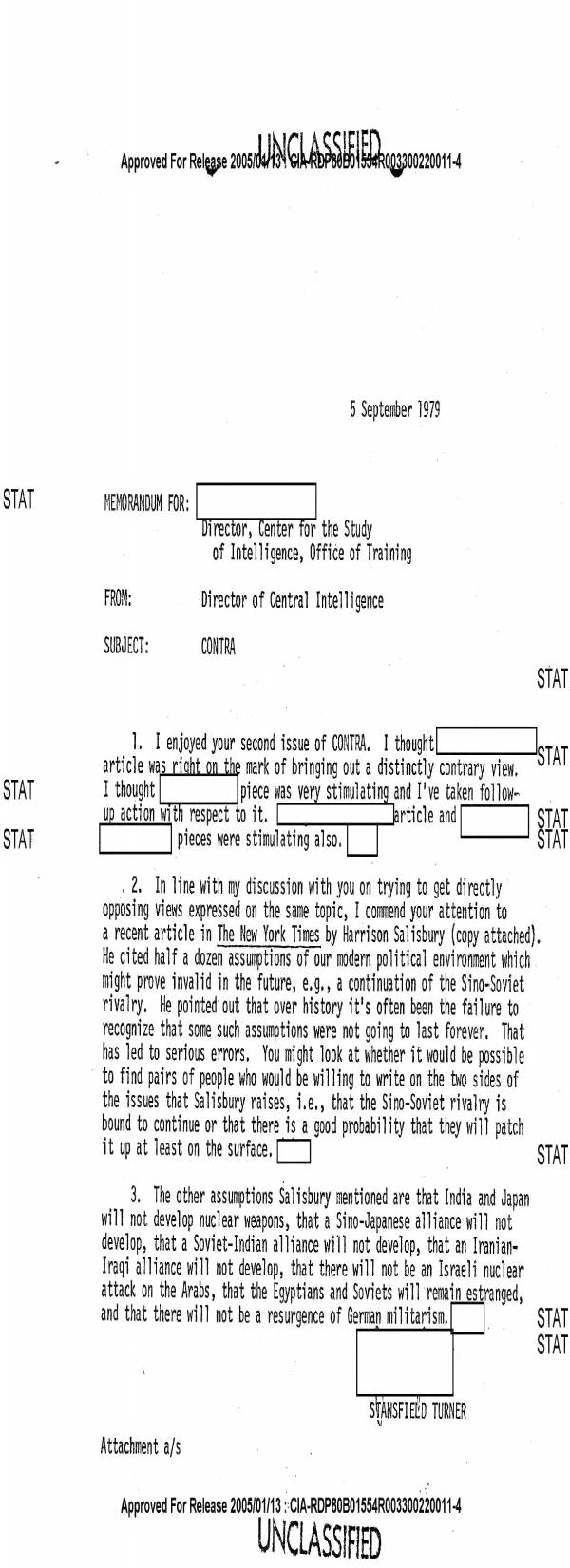
1. I enjoyed your second issue of CONTRA. I thoughtL__
article was_ri mark of bringing out a distinctly contrary view.
STAT I thought piece was very stimulating and I've taken follow-
up action with respect to it. article and aaa STAT
STAT ana pieces were stimulating also. TAT
. 2. In line with my discussion with you on trying to get directly
opposing views expressed on the same topic, I commend your attention to
a recent article in The New York Times by Harrison Salisbury (copy attached)..
He cited half a dozen assumptions of our modern political environment which
might prove invalid in the future, e.g., a continuation of the Sino-Soviet
rivalry. He pointed out that over history it's often been the failure to
recognize that some such assumptions were not going to last forever. That
has led to serious errors. You might look at whether it would be possible
' to find pairs of people who would be willing to write on the two sides of
the issues that Salisbury raises, i.e., that the Sino-Soviet rivalry is
bound to continue or that there is a good probability that they will patch
it up at least on the surface.[ | . STAT.
3. The other assumptions Salisbury mentioned are that India and Japan
will not develop nuclear weapons, that a Sino-Japanese alliance will not
develop, that a Soviet-Indian alliance will not develop, that an Iranian-
Iraqi alliance will not develop, that there wil] not be an Israeli nuclear
attack on the Arabs, that the Egyptians and Soviets will remain_estranged,
and that there will not be a resurgence of German militarism. STAT
STAT
Attachment a/s
Approved For Release 2005/01/13 :CIA-RDP80B01554R003300220011-4
UNCLASSIFIED
Approved For Release 2005/01/13 : CIA-RDP80B01554R00330022001 1-4
On Aug. 23, 1939, the German For-
- eign Minister J oachim von Ribbentrop
secretly arrived in Moscow! on Aug.
24, he and Stalin signed the Sovict- Nazi
pact, and seven days later World War
~The Hitler-Stalin Pact The canny statesman today would
look around the. world for the “‘incon-
ceivables”: rapprochement between
Moscow and Peking; military and nu.
r clear armament of Indla and Japan; a
{1 began with the Wehrmacht invasion By Harrison E. Salisbury); 4, Sino-Japanese alliance; a Soviet-InRf
of Poland. dian alliance; an. Iranian-Iraqi als,
+> The Soviet-Nazi pact struck the un- Hance; an Israeli nuclear attack on the
easy post-Munich world like a bolt of Again, they were wrong. To many, the. * would never parieipate in World War Arabs; a new Egyptian-Soviet deal; a
lightning from a clear summer sky. I , Nazi attack on Russia on June 22, 1941, I. . resurgence of German militarism.
was vacationing on the hot, desolate was as big a surprise as the August That Japan would never attack the All of these developments Ile in that
beach of Nags Head, N.C., and I was 1939agrecment. - ' United States. vast imaginative region that Herman
incredulous as 1 heard the news crack- ~ What World War II proved was that That Pearl! Harbor was Ainvulner- “Kahn calis “thinking the unthink.
ling out from a portable radio, No one’ not one piece of conventional wisdom | able, able.”’ Each is unthinkable. Probably
believed it. War, yes. We had lived on was viable. Every basic presumption of the dip- none will happen. But a prudent
‘its brink for months. But a deal be- What were the clichés of 1939? lomats and the generals proved statesman, a man who understands
tween those deadly enemies, Hitler "That France possessed “the best wrong. ‘ .the lessons of Aug. 24, 1939, will not
and Stalin? Inconceivablei landarmyin Europe.” . What have we learned in the 40 write them all off. :
It is that inconceivability that is That the MASHL Line was ‘‘impreg- years since Aug. 24, 1939? Not much. Foreign policy, the balance ofworid :
worth pondering today. nable.” We went into the cold war convinced - powers, the interrelationship of states
It is the “inconceivable"’ that again that Communism was indivisible, that is not something set in concrete. Itis in
and again puts the world into peril. Marxism was a Gibraltar with its constant motion like the tides of a tur-.
The imaginative capability of diplo-
mats Is traditionally Hmited, Generals = Rie 40years, > headquarters
ran itall,
in the Kremlin. Stalin © bulent sea.
Forty years after the most devastat-
always prepare to fight the last war * When Marshal Tito first broke with ing international event of the century,
again, and statesmen occupy them- the non-lessons of Stalin, most diplomats and many there is no evidence that its ipssons
selves repeating Versailles or Vienna 4? a 3
Americans
*
called it a Communist
a ard
have been absorbed, analyzed or, 1
or Potsdam, ‘ trick, How could there be divisions deed, even remembered by the m
a it is the inconceivable that hap- . the inconceivable within the Marxist monolith? When who ‘make American policy or those
. ‘ the Soviet Union and Communist upon whom that policy rests for its
: Agathist the judgment of every CX- China parted ways In the late 1950’s, SUppOES, the American people, *
pert, Hitler and Stalin did get together That theey Air Force hadn’t a John Foster Dulles refused to believe
and the pact of Aug, 24, 1939 triggered chance to beat off Herman Goring? S ’ ft, When I reported on Soviet-Chinese *
World War II, What lesson did the dip- : Luftwaffe, +.’ conflict in Outer Mongolia in 1959, this Harrison E. Sian retired Associ-
. _Jomats learn from that? A simple one,
That Germany oe never‘fight a * evidence of a basic split between the ~ ate Editer of The New York Times,
+4. They now believed (Stalin among :“ twofront war. - => PHP “. {Communist giants was pooh-poohed; it sewas The Times’s correspondent in ,
3 --That the Red Army wold not last a cn continued to be until the Nixon-Kissin-
. + them) that the‘pact would endure far = “ie .:' Moscow for many years. He is author :
oat- of “Black Night, White Snow,”
: into the future, that Nazi Germany * month against Nazi blitakrieg. ©. ve 277 ger “opening” to China in 1971-72, a revi-
_ and Stalinist Russia: would stay In That once was enough— theUnited Today, conflict and war in the “‘indi- sionist examination of the Russian
partnership and divide the world. States had entered World War I and visible” Communist world is common, Revolutions of 1905 and 1917, :
Approved For Release 2005/01/13 : CIA-RDP80B01554R003300220011-4