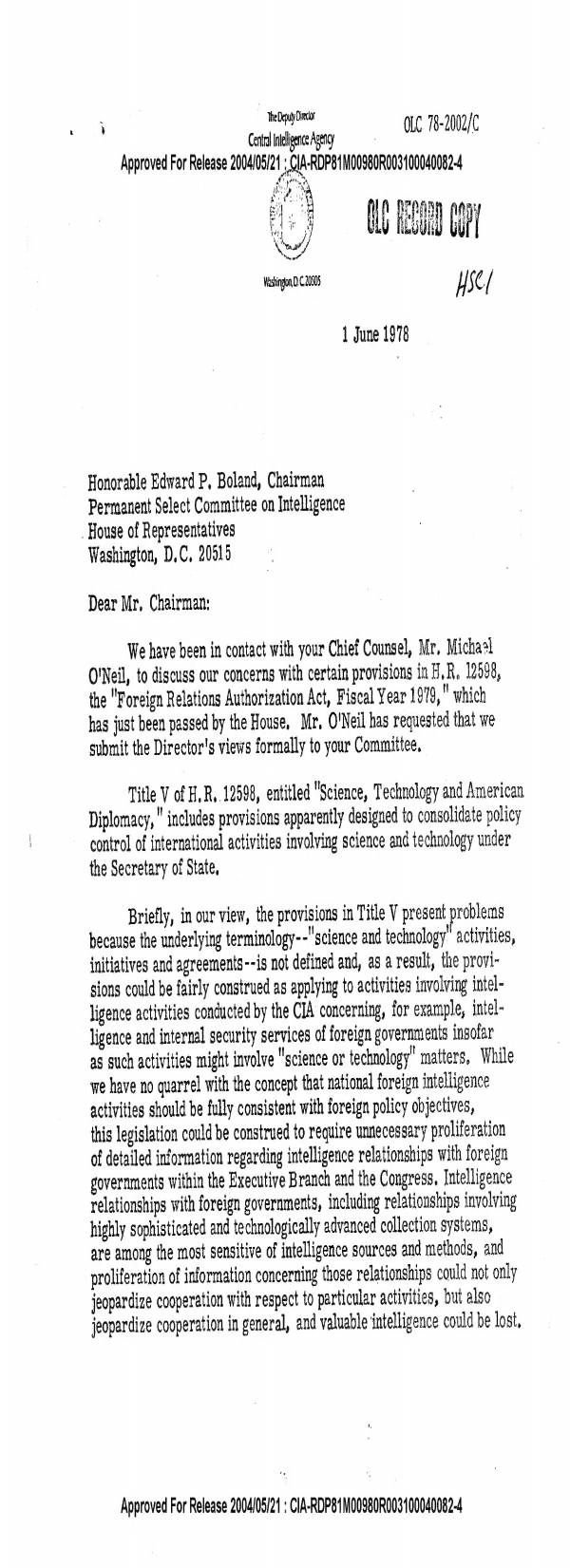
Plain-English summaryDeputy Director of Central Intelligence Frank Carlucci writes to House Permanent Select Committee on Intelligence Chairman Edward P. Boland detailing concerns regarding Title V of H.R. 12598. The letter states that undefined terms concerning science and technology could inadvertently apply to CIA intelligence activities and sensitive liaison relationships with foreign governments. Carlucci argues that intelligence activities should be specifically excluded from the bill to avoid overriding the Director's statutory authorities and altering congressional oversight channels.
Key line (verbatim from the document)“We believe these science and technology provisions paint with too broad a brush, and that intelligence activities should be specifically excluded . from coverage”
Summary written with AI help from the document text and checked against it; the key line is matched word for word to the text. Read the original before citing.
Full text (10,550 characters)
The Deputy Director x
wl
Central Intelligence Agency OLC 78-2002/C
Approved For Release 2004/05/21 ; CIA-RDP81M00980R003100040082-4
oer
Pasha
eeeaen 20505 4.J ¢ /
j June 1978
Honorable Edward P. Boland, Chairman
Permanent Select Committee on Intelligence
. House of Representatives
Washington, D.C. 20515
Dear Mr. Chairman:
We have been in contact with your Chief Counsel, Mr. Michal
O'Neil, to discuss our concerns with certain provisions in H.R. 12598,
the "Foreign Relations Authorization Act, Fiscal Year 1979, " which
has just been passed by the House. Mr. O'Neil has requested that we
submit the Director's views formally to your Committee.
Title V of H.R. 12598, entitled "Science, Technology and American
Diplomacy," includes provisions apparently designed to consolidate policy
control of international activities involving science and technology under
the Secretary of State.
Briefly, in our view, the provisions in Title V present problems
because the underlying terminology--"science and technology’ activities,
initiatives and agreement s not defined and,
--is as a result, the provi-
sions could be fairly construed as applying to activities involving intel-
ligence activities conducted by the CIA concerning, for example, intel-
ligence and internal security services of foreign governments insofar
as such activities might involve "science or technology" matters. While
we have no quarrel with the concept that national foreign intelligence
activities should be fully consistent with foreign policy objectives,
this legislation could be construed to require unnecessary proliferation
of detailed information regarding intelligence relationships with foreign
governments within the Executive Branch and the Congress. Intelligence
relationships with foreign governments, including relationships involving
highly sophisticated and technologically advanced collection systems,
are among the most sensitive of intelligence sources and methods, and
proliferation of information concerning those relationships could not only
jeopardize cooperation with respect to particular activities, but also
jeopardize cooperation in general, and valuable intelligence could be lost.
Approved For Release 2004/05/21 : CIA-RDP81M00980R003100040082-4
� ‘
Approved For Release 2004/05/21 : CIA-RDP81M00980R003100040082-4
ressional and Executive
in discussions we have had with cong
legislation, we have been informed
Branch officers familiar with this
nded to fall within the terms of
that intelligence activities are not inte
bill filed by the International
Title V. Although the report on this
in the analysis of subsection.
Relations Committee contains language
rt language fails to address
503(c) to this effect, we believe the repo
title ig not clear. This lack
fully our concerns that the scope of the
elsewhere in the title, .
of clarity, coupled with specific language 7
presents further problems; for example:
Secretary of
1. Subsection 503(a) requires that the
in consultation with
State, on behalf of the President and 45
nce and Technology
the Director of the Office of Scie
fully informed and
Policy, ensure that the Secretary is
consulted before any agen undertakes any initiative
respect to any ~
involving science an d can ology with r prov isio n. -.
overnment “notwithstandin any othe
. forei iths tand ing
mpnasis aaded. @ phrase notw
of law. --
n of law" coul d be inte rpretedas
any other provisio ty to ate
onsibili
superseding the Director's statutory resp ized
from. unauthor
protect intelligence sources and methods of 1947, as amended,
onal Secu rity Act
disclosure under the Nati 7
ed section.
as to obligations imposed by the propos
of an annual
n
9, «Subsection 503(b) requires submissio
tion of existing inter-
report to the Congress on the continua ements, including
national programs, activities and agre
foreign, policy implica-
descriptions of them, an analysis of
l benefits (and, according
tions, the scientific and technologica
of funding for and
to the report, dangers), the adequacy
and personnel require-
administration of such activities, .
Federal employeeswha
ments and standards for training of n coul d be inte r-
provisio
participate in such activities. This ties for
responsibili
preted as reordering Executive Branch relationships with
erni ng inte llig ence
formulating policies conc
involve science and tech-
foreign governments insofar as they
lligence relationships. —
nology, and for coordinating such inte
r 12036, such responsi-
Under section 1-601 of Executive Orde
with the Director of Central
bility and authority currently resides a en Sint
ae
Intelligence.
Approved For Release 2004/05/21 :CIA-RDP81 M00980R003100040082-4
� Approved For Release 2004/05/21 : CIA-RDP81M00980R003100040082-4
3. Subsection 504(a) establishes that the Secretary of
State has primary responsibility for coordination and over-
sight with respect to all international scientific and techno-
logical activities of the U.S. Government, including,
according to the report, "agency-to-agency agreements
for cooperation in highly ... sensitive areas of science or
technology."' This language could be viewed as shifting
responsibilities to the Department of State and, in the
Congress, to the Department's oversight committees.
Insofar as intelligence matters could be construed
to fall within the scope of Title V, absent clarification of
its scope, we believe subsection 504(a) could alter what,
in our view, is the appropriate oversight mechanism for
intelligence matters--namely, the Intelligence Committees.
Although subsection 503(c) incorporates language protecting
against the public disclosure of intelligence information as a result of
the provisions in that subsection, this language addresses only the
issue of public disclosure and not the issues discussed above. We
believe these science and technology provisions paint with too broad a
brush, and that intelligence activities should be specifically excluded .
from coverage.
While the companion bill in the Senate, S. 3076, does not con-
tain science and technology provisions similar to those in Title V of
H.R. 12598, there are other provisions in the Senate bill which are
of concern to us. These include provisions amending the so-called
"Role of the Ambassador Legislation’ (22 U.S.C. §2680a) and the so- .
called "Case/Zablocki Act" (1 U.S.C. §112b).
We would welcome the opportunity to discuss these matters with
you in an effort to ensure that the Director's equities are not adversely
affected by the legislation. Time has not permitted securing advice from
the Office of Management and Budget as to the relationship of this
report to the Administration's program, although we have sent a report
to OMB and are discussing these matters with that Office.
Sincerely,
SIGNED
Frank Carlucci
Distribution:
- Orig - Addressee
- DCI
- DDCI
- ER 3
- DDS&T
‘ DDO/PCS
- OCC
~ OLC Subejcet
REY
eee
Pee- OLC Chrono
OLC: RLApsmoved FrryReigase 2004/05/21 : CIA-RDP81M00980R003100040082-4
�