Full text (42,656 characters)
Approved For Release re 50) ol preteen eee 531-0934,
Central Intelligence Agency
cance 18 JUL 1981
The Honorable Edward P. Boland
Chairman, Permanent Select
Committee on Intelligence
House of Representatives
Washington, D-C. 20515
Dear Mr. Chairman:
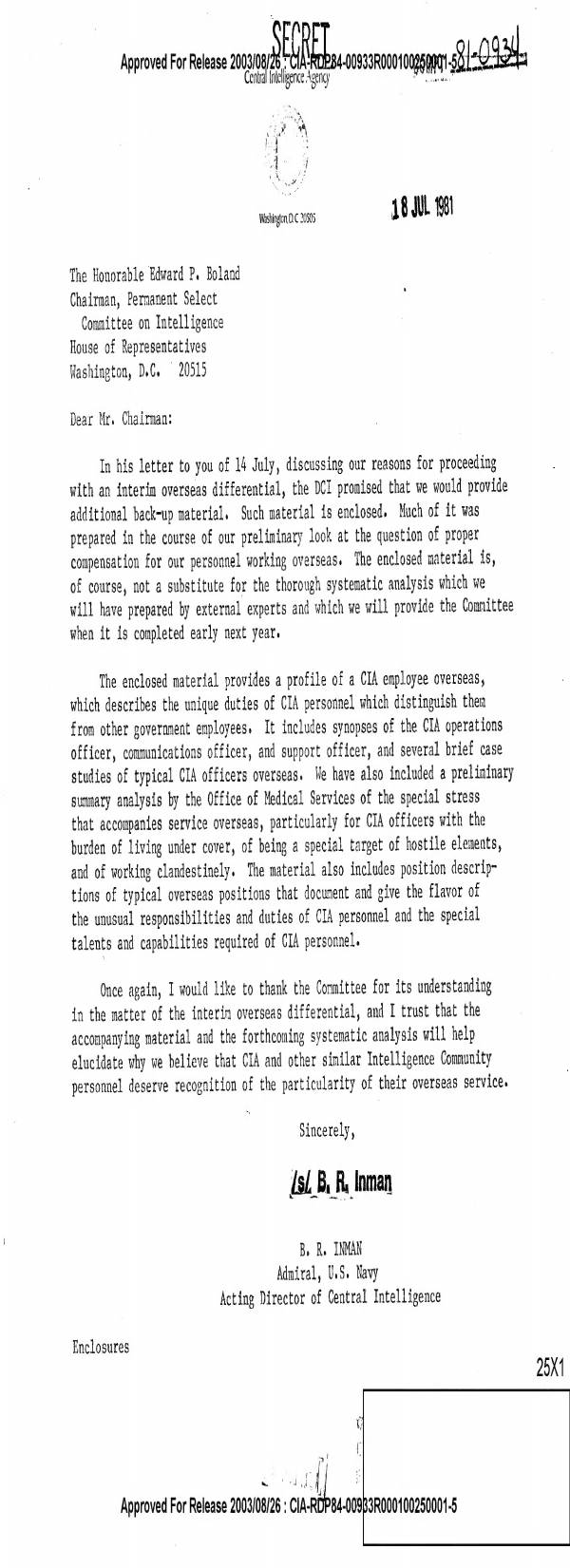
In his letter to you of 14 July, discussing our reasons for proceeding
with an interim overseas differential, the DCI promised that we would provide
additional back-up material. Such material is enclosed. Much of it was
prepared in the course of our preliminary look at the question of proper
compensation for our personnel working overseas. The enclosed material is,
of course, not a substitute for the thorough systematic analysis which we
will have prepared by external experts and which we will provide the Committee
when it is completed early next year.
The enclosed material provides a profile of a CIA employee overseas,
which describes the unique duties of CIA personnel which distinguish then
from other government employees. It includes synopses of the CIA operations
officer, communications officer, and support officer, and several brief case
studies of typical CIA officers overseas. We have also included a preliminary
summary analysis by the Office of Medical Services of the special stress
that accompanies service overseas, particularly for CIA officers with the
burden of living under cover, of being a special target of hostile elements,
and of working clandestinely. The material also includes position descrip-
tions of typical overseas positions that document and give the flavor of
the unusual responsibilities and duties of CIA personnel and the special
talents and capabilities required of CIA personnel.
Once again, I would like to thank the Committee for its understanding
in the matter of the interin overseas differential, and I trust that the
accompanying material and the forthcoming systematic analysis will help
elucidate why we believe that CIA and other similar Intelligence Community
personnel deserve recognition of the particularity of their overseas service.
Sincerely,
B, R, Inman
ési
Be Re INMAN
Admiral, U.S. Navy
Acting Director of Central Intelligence
Enclosures
25X1
>
ty-Seta
Approved For Release 2003/08/26 : sa! ee ee
� Approved For Release 2003/08/26 : CIA-RDP84-00933R000100250001-5
Distribution:
Orig - Chairman, HPSCI wfatts
~ SAC/Defense (Dwight E. Dyer) "
- SSCL (Jack Blake) um
- DCL nN
- DDCL "
- ER
- DDA w/atts
~- ADDA os
~ D/Finance
- D/Personnel
~ DD/OP/PAE tt
t DD/ODP uy
~ ¢/DO/CMS i
—- G/LLB mt
— GE "
25X1
- Ics "
- Compt
- D/Compt ue
- C/BMG M
- C/AG
~ C/OG v
PE- Compt
RPE
RPP
ee
eee
EE
PRE Subj
Approved For Release 2003/08/26 : CIA-RDP84-00933R000100250001-5
� Approved For Release 2003/08/26 : CIA-RDP84-00933R000100250001-5
THE CIA EMPLOYEE OVERSEAS: A PROFILE
1. Short Description of:
a. Agency Ops Officer Overseas
b. Agency Support Officer Overseas
c. Agency Communications Officer Overseas
- Excerpts from
Nm . Five Representative Case Studies
Actual Performance Reports
Sampling of Position Descriptions
tA . A Representative
4. A "Quick" Analysis of the Hay Study
Services Views of Stress in
5. Office of Medical
Overs eas Servi ce
Approved For Release 2003/08/26 : CIA-RDP84-00933R000100250001-5
�Approved For Release 2003/08/26 : CIA-RDP84-00933R000100250001-5
Short Description of:
a. Agency Ops Officer Overseas
b. Agency Support Officer Overseas
c. Agency Communications Officer Overseas
Approved For Release 2003/08/26 : CIA-RDP84-00933R000100250001-5
�25X11 Approved For Release 2003/08/26 : CIA-RDP84-00933R000100250001-5
Next 7 Page(s) In Document Exempt
Approved For Release 2003/08/26 : CIA-RDP84-00933R000100250001-5
�Approved For Release 2003/08/26 : CIA-RDP84-00933R000100250001-5
Five Representative Case Studies - Excerpts
from Actual Performance Reports
Approved For Release 2003/08/26 : CIA-RDP84-00933R000100250001-5
�25X1 Approved For Release 2003/08/26 : CIA-RDP84-00933R000100250001-5
Next 4 Page(s) In Document Exempt
Approved For Release 2003/08/26 : CIA-RDP84-00933R000100250001-5
�Approved For Release 2003/08/26 : CIA-RDP84-00933R000100250001-5
A Representative Sampling
of Position Descriptions
Approved For Release 2003/08/26 : CIA-RDP84-00933R000100250001-5
�25X1 Approved For Release 2003/08/26 : CIA-RDP84-00933R000100250001-5
Next 32 Page(s) In Document Exempt
Approved For Release 2003/08/26 : CIA-RDP84-00933R000100250001-5
�Approved For Release 2003/08/26 : CIA-RDP84-00933R000100250001-5
A "Quick" Analysis of the Hay Study
rie
Approved For Release 2003/08/26 : CIA-RDP84-00933R000100250001-5
� ee ees —
ae
‘ omy
wee eee hy J
Approved For Release 2003/08/26 : CIA-RDP84-00933R000100250001-5
I. TOPIC
of the Hay Associates "Study to Assist the Department
An analysis
in an Evaluation of the Compensation System of the United States
of State
25X1 Foreign Service." [ |
TI. BACKGROUND
Foreign Service jobs
A. Hay Associates was contracted with to assess
comparability with other Federal positions, linkage with the
as to content,
classification system, and to propose a Foreign
General Schedule pay/grade
25X11 Service Grade System. [ |
determine the
| B. [t applied "Hay Job Evaluation Techniques'to
domestic and
relative job content of selected Foreign Service positions,
and pay, both within
overseas, arid the relationship of Foreign Service work
employers, including the U.S. Civil
the Department and to other external
and statistical analysis techniques, it
Service. By data collection
linkage with the General Schedule pay/grade
determined that the historical
longer appropriate and proposed a new linkage
classification system was no
25X11 system and pay scale. [|
the Congress approved the study's concepts and a new
C. Ultimately
in an average salary increase of
Foreign Service Pay Scale which resulted
25X1 9.6 percent. a=
acknowledged (page 27, Volume I)
D. in its study, Hay Associates
of overseas service is necessarily and properly felt by the
tt .The impact
and for this reason jt is most appropriately addressed
entire Foreign Service
system. This concept will be developed in the Proposed
by the grade/pay
section of this report." The consultants noted that the
Grade Structures
25X1
ae or
‘
Approved For Release 2003/08/26 : GIA-RDP84-00933R000100250001-5
� "er: or
oe See
Approved For Release 2003/08/26: A 61A-RDP84-00933R000100250001-5
content to context of overseas service (meaning the difficulty associated
with maintaining a mobile service operating under stressful and less than
secure Circumstances) should be about 15 percent and made as "...an incremental
addition to the Foreign Service grade/salary structure..." [| 25X1
III. DISCUSSION
A, ‘The Foreign Service Pay Scale (FS) resulted in the following sample
linkage changes.
1. FSO-3 (now FS-1) jobs were found comparable with GS-15 rather
than between GS-15 and GS-14 as was the historical linkage. |
Z. FSO-4 (now FS-2) were found similar to GS-14 rather
than to GS-15 as was the historical linkage.
3, FSO-6 (acti KS-4) were found comparable to GS-11 jobs rather
than to GS-09 as was the historical linkage.
4. Similar linkage changes were made between FSS and lower
25X1 eraded GS grades. a
B. In using its "Hay Job Evaluation Techniques" points to establish
points for the Civil Service job samples in the General Schedule to prove
job difficulty, Hay relied upon prior studies (1976 Civil Service Comnission
study and the 1975 QRMC study). Points for the Foreign Service jobs upon
which the linkage was based were determined during the State Department survey.
As CIA jobs were not included in either study, the application of the "Hay
Job Evaluation Techniques’”’ to CIA jobs, particularly overseas might indicate
that the CIA jobs rank higher in point count than the normal General Schedule
25X1 positions. | |
C. Hay documented (pages 1-4, Volume I) peculiar requirements of
the Foreign Service all of which could be applied to base positions within
CIA. This lends additional credence to the long-held belief that CIA
ioe
Approved For Release 2003108/26 : CIA-RDP84-00933R000100250001-5
� c £ em
Sine i.2 =
a Yaad tom Se hy
Approved For Release 2003/08/26 : CIA-RDP84-00933R000100250001-5
similar to Foreign Service positions than to normal we
positions are more
25X1 sneral Schedule positions.
IV. CONCLUSIONS
A. ‘The impact of overseas service finding by Hay Associates can
be applied equally to CIA positions overseas. It appears this finding
of a 15 percent factor were included in assigning "points" to
and the addition
Foreign Service jobs. This 15 percent factor might apply equally to CIA
25X11 jobs overseas. dl
The change in the historical linkage between the Foreign Service
B.
and the Ceneral Schedule had an adverse impact on the salary of CIA employees
Approved For Release 2003/08/26: CIA-RDP84-00933R000100250001-5
�Approved For Release 2003/08/26 : CIA-RDP84-00933R000100250001-5
Office of Medical Services Views of
Stress in Overseas Service
DE
Approved For Release 2003/08/26 : CIA-RDP84-00933R000100250001-5
� Approved For Release 2003/08/26 : CIA-RDP84-00933R000100250001-5
The following is an excerpt from a recently completed
Agency Inspector General survey of the Office of Medical
Services. It relates to service overseas.
Overseas living has always had its stresses: the
ove itself, the three to six months settling-in process,
adjusting to an alien culture, learning to communicate in
a Foreign language, living cover, and requirements for
night working hours and extended TDY travel. All these
problems still face our people going overseas today, but
added to them are some new stress factors, which reflect
changes both in our own society and in the foreign environ-
ment.
Selection and screening of personnel for overseas assign-
inents must take into account both the increasing stress of
overseas life and particular stress factors at individual
field stations. This is a problem not only for OMS, of
coursg but for other components' line management as well.
In this regard, the principal lesson we learned in our field
visits was that stress factors at individual posts change with
the passage of time, and neither OMS nor other managers
should rely on outdated knowl edge and experience in assigning
or clearing personnel for service overseas.
ae tee pete,
or lReET
we
Approved For Release 2003/08/26 : CIA-RDP84-00933R000100250001-5
� Approved For Release 2003/08/26 : CIA-RDP84-00933R000100250001-5
Since life overseas is substantially more stressful
than in the past, however effective screening procedures ~
we must do more to prepare our employees and their
are,
families to cope with life abroad, particularly in more
environments, or else be prepared to deal with
stressful
a higher incidence of stress-related problems overseas.
Stress factors which today are making life overseas
increasingly less pleasant include:
i
Line in American and U.S. Government Prestige Abroad
o
The decline in US prestige is an intangible factor,
which probably affects older employees and their families
more than younger personnel. As a country and as individuals
we simply are not accorded the same respect overseas as
was the case in the 1950's and 1960's, and it hurts.
Moreover, with less disposable income, our people are generally
unable to cut as wide a social swath as they used to.
Meanwhile, local businessmen, even in underdeveloped countries,
have become wealthy and consume with high conspicuousness;
and representatives of American business firms live
comfortably, with perquisites not available to government
employees. In some areas the Foreign Service or CIA
employee overseas looks on himself as a second class citizen.
as an official representative of the US Government, he
Also,
is easily identified by the local population and may be
subjected to terrorist activity.
SECRET
we ne oe tN he
Approved For Release 2003/08/26 : CIA-RDP84-00933R000100250001-5 -
� Approved For Release 2003/08/26 : CIA-RDP84-00933R000100250001-5
The High Cost of Living
service overseas as a means of
Many employees see
either merely to have a small nest
accumulating savings,
purposes, such as buying a home or
egs, or for concrete
children's education. In many posts,
financing their
those without a differential, this is now
particularly
for lower graded employees. There
Aifficult, especially
of living allowances, but they seem to lag
aee cost
rate of inflation. On this trip no one
tehind the actual
the issue was losing money by
with whom we discussed
overseas; but the attractiveness of
virtue of being
a means of saving for a rainy day is
overséas work as
fast diminishing.
up to 25 percent are provided as
Post differentials
for the hardships encountered in some areas.
compensation
seek assignments to these stations as a means
Some people
financially, knowing that enduring the
of getting ahead
at least will make for a more secure future.
hardships
if the extra money is not part of the motivation,
Even
compensation for living in these areas.
it is a welcome
25X1
is resentment if employees do not see
Hhere
in the conditions of the post, yet the
improvements
income they were counting on is diminished.
F adh hel cate tata OEted
Qe DE
Approved For Release 2003/08/36 7CIA-RDP84-00933R000100250001-5
� Ra. ee ae A =
aad baa Mee EOL dee i
Approved For Release 2003/08/26 : CIA-RDP84-00933R000100250001-5
The Working Spouse
Relevant to the problem of overseas assignments and
concomitant stress is the current phenomenon of the working
spouse and loss of income when one breadwinner must quit
or take a much lower salary overseas. Even if the
spouse initially agrees to quit and accept the overseas
assignment, as time goes on, friction can develop due to
loss of career status as well as tangible income.
Problems of Living in Large Cities
Cities abroad are expanding in size, generally at an
even more rapid rate than American cities, with predictably
severe consequences: breakdowns in public utilities,
transportation and other services; massive traffic jams;
pollution of the air and water; decline in the availability
Gf recreational facilities; increase in crime and urban
violence; and the general unpleasantness of existence in
a densely populated areca: crowded streets, crowded shops,
crowded apartment houses, endless street noises, and the
Like.
25X1
Terrorism and Security
Corp
eh TAL
cT
Approved For Release 2003/08/26 : CIA-RDP84-00933R000100250001-5
� 7 sa ‘wee
Approved For Release 2003/08/26 : CIA-RDP84-00933R000100250001-5
anxiety level of Life in some posts.
increased the
foreign service families that they
It is a tribute to all
25X11
effectively under such adverse security
continue to perform
conditions
25X1
problem of identification of CIA
particularly insidious
press continues with stressful consequences
employees by the
25X1
‘ : :
for the employee and his family.
Fear_of Catastrophic Disease or
factor was with us in "the good old days,"
This stress
much a source of stress today. Many cities
and remains very
stations and bases are located have medical
where our
primitiveness, filthy, lacking
Facilities of frightening
and anesthetics, and with poorly
in drugs, antibiotics
and orderlies. Personnel at these posts,
trained nurses
ne ee
6 : CI[A-RDP84-00933R000100250001-5
� Approved For Release 2003/08/26 : CIA-RDP84-00933R000100250001-5
no matter how high their morale otherwise, live with
a lurking fear that the sudden onset of disease, or a
serious accident, will compel their admission to these
facilities. There are steps the RMO can take to reduce
this stress factor, including briefing employees on
ioecal diseases and appropriate measures to take if
confronted by them and awareness of the local hospital
in all posts. fits doing such a 25X1
sjtuation
Survey.
Emergency situations ae frequently eased when an RMO
25X1
can be rushed to the scene to take charge and, if necessary,
to medevac.
25X1
This is another stress factor that has been around
for a long time. Operations officers are often required
to work at night, which leaves the spouse alone or allows
for little private exchange between marriage partners.
Approved For Release 2003/08/26 : CIA-RDP84-00933R000100250001-5
� SECRET
Approved For Release 2003/08/26 : CIA-RDP84-00933R000100250001-5
Pcudivencaes for communications and
Frequent travel
service employees with regional responsibilities
technical
the spouse to manage alone. As operational
also leave
increase, and personnel resources decline,
yequirements
worsen. The political unrest and security
these problems
some areas increases anxiety about these
threat in
requirements. The absence of one partner,
professional
husband, frequently leaves the wife to cope
usiiaLlly the
with increasingly difficult living conditions.
hy herself
to work, no language training and few
With no opportunity
the wife may feel lonely, bored and isolated
sucial outlets,
the local community. All these factors put additional
froin
strains on the family relationship.
Chana oak aos
anes
ornt Eee,
1 ba j
a ee i
Approved For Release 2003/08/26 : CIA-RDP84-00933R000100250001-5
� we 2
Approved For Release 2003/08/26 : CIA-RDP84-00933R000100250001-5 fy?
23 May 1980 (}
MEMORANDUM FOR: Director of Medical Services
25X1
Pres [|Chief, Center for ounterterrorism and
"ae (
-
Crisis Response
7 WISTECT : Stress of Overseas Assignment
ved in
1. As you are aware, our Staff has been invol
context
prepdring people for overseas assignments in the
natio nal terro rism. In
of the increasing threat of inter ced
new and expe rien
this work we have dealt with both
enployees from all Directorates. During and following
the reactions
crises, we have had the opportunity to observe
TDY trave l has allowed
of a number of involved individuals.
ons aroun d the
us to observe personnel in a number of stati
world.
and
2. The increasing hostility to Americans abroad,
ased the
particularly to US government officials, has incre
yees and their famil ies.
level of anxiety among both emplo
Specifically, the threat of violence has become more
generalized and unpredictable. No longer is it sufficient
risk to oneself terms
or one’s family in
to calculate the
de terrorists,
of a known enemy; real sources of danger inclu
and mobs, all of which can occur , it seems, at.
criminals,
At the same time, there is the
any time and at any place.
less able
perception (real or imagined) that the USG is
affor d adequ ate prote ction to its
and/or less willing to
quate host
employees, viz. increased dependence on inade
government resources, apparent ambig uous polic y statements,
In many cases employees succe ssful ly emplo y denial
etc. .
elves , but their
in dealing with this stress for thems
conce rns for
problems become all too apparent in their 25X1
their families. 3
CONFIDENTIAL ,
_ Approved For Release 2003/08/26 : CIA-RDP84-00933R000100250001-5
� oe ae Naw WZ ENE PR bd SME GA
7 GLE .
Approved For Release 2003/08/26 : CIA-RDP84-00933R000100250001-5
3. More generally we have found that families are
as
playing a greater role in employee feelings about overse
assignment. For years spouses have had a difficult role
l,
of supporting employees by performing a number of operationa
functions about. which they know very little. Spouses are
becoming less tolerant of this exclus ion and want greater
recognition. At the same time there is the increa sing
incidence of spouses having independent careers; it is a
rare overseas assignment where one of the family 's careers
does not suffer.
4. In the past the glamour of living overseas, as
welt as significant financial benefits, helped employees
deal with the above general problems as well as the more>
specific stresses of particular locations (such as the
cultural problems women have in the Middle East). Conditions
have now changed so that the major benef it we hear from
emplayees about serving overseas is that it takes them away
from the problems at Headquarters. However, the proble ms
at ilendq uarter s contri bute to the stress es overseas insofar
as officers in the field feel they are getting insufficient
support from Headquarters.
S, Increasing the financial rewards of overseas service
may reduce, but will not eliminate, the effects of the above
stresses. Its more direct effect would be to signal'a .
reversal of the perceived trend to downgrade overseas duty
exemplified by the Congressional and Treasury pressures to 25X1
reduce allowances and tax benefits. :
CONFIDENTIAL -
Approved For Release 2003/08/26 : CIA-RDP84-00933R000100250001-5
�25X1 Approved For Release 2003/08/26 : CIA-RDP84-00933R000100250001-5
Next 3 Page(s) In Document Exempt
Approved For Release 2003/08/26 : CIA-RDP84-00933R000100250001-5
�