Full text (1,067,932 characters)
100th Congress S. Prt.
COMMITTEE PRINT 100-165
2d Session
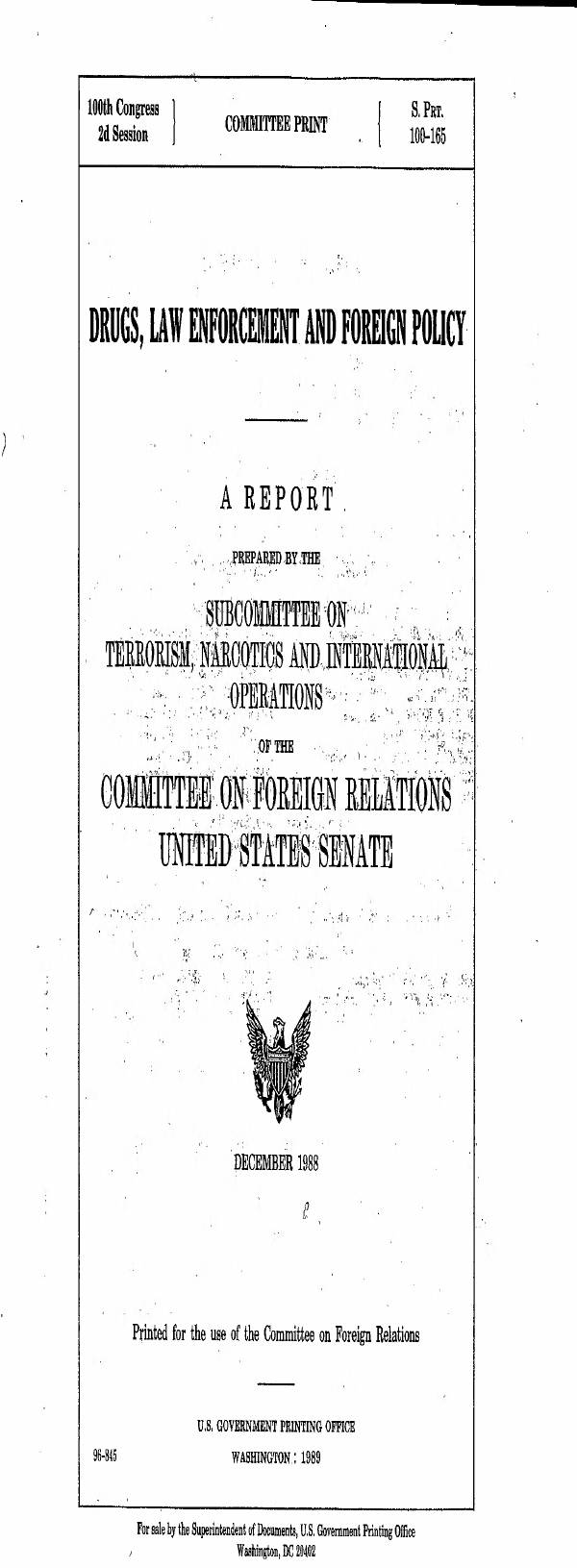
DRUGS, LAW ENFORCEMENT AND FOREIGN POLICY
A REPORT
PREPARED BY THE
SUBCOMMITTEE ON
TEKKORJSM, NARCOTICS AND INTERS
• OPERATIONS
OF THE . .. );
COMMIT TEE ON FOREIGN REI iATFONS
II NJTED STATES SENATE
r .
i
DECEMBER 1988
e
Printed for the use of the Committee on Foreign Relations
U.S. GOVERNMENT PRINTING OFFICE
96-845 WASHINGTON : 1989
For sale by the Superintendent of Documents, U.S. Government Printing Office
Washington, DC 20402
� LETTER OF TRANSMITTAL
U.S. Senate,
Committee on Foreign Relations,
Washington, DC, April IS, 1989.
Hon. Claiborne Pell,
Chairman, Committee on Foreign Relations,
U.S. Senate, Washington, DC,
Dear Mr. Chairman: Two years'Sago, you directed the Subcom-
COMMITTEE ON FOREIGN RELATIONS mittee on Narcotics, Terrorism and International Operations to
conduct an investigation regarding the links between foreign
CLAIBORNE PELL; Rhode Island, Chairman
policy, narcotics and law enforcement in connection with drug traf-
JOSEPH R. BIDEN, Ja., Delaware " ' JESSE HELMS, North Carolina ficking from the Caribbean and Central and South America to the
PAUL §. SARBANES, Maryland ' RICHARD G, LUGAR, Indiana
ALAN CRANSTON, California NANCY L. KASSEBAUM, Kansas United States. This Report is the final written product of that in-
CHRISTOPHER J. DODD, .Connecticut /RUDY BOSCHWTTZ, Minnesota vestigation inthe 100th Congress.
'JOHN F. KERRY, Massachusetts LARRY PRESSLER, South Dakota Pursuant to your direction, the Subcommittee conducted four-
PAUL SIMON, Illinois FRANK H. MURKOWSKI, Alaska
TERRY SANFORD, North Carolina . PAUL S. TREBLE, Jr., Virginia teen days of open hearings, nine executive sessions, and received
BROCK ADAMS, Washington ■ DANIEL J, EVANS, Washington testimony from 27 witnesses. In addition, the staff deposed an addi-
DANIEL P. MOYNIHAN, New York ' . MITCH McCONNELL, Kentucky tional 20 witnesses. Thirty subpoenas were issued, many calling for
Geeyld B. Chbistianson; Staff Director the production of extensive documentation.
James P/- Lucieb, Minority Staff Director
The Subcommittee's investigations resulted in a wide-ranging
review of past policies and practices in handling foreign policy and
Subcommittee on Tehboeism, Narcotics and International Operations the war on drugs. It is our privilege to transmit the report contain-
JOHN F. KERRY, Massachusetts, Chairman ing findings and conclusions based on the investigation, a country-
BROCK ADAMS, Washington MITCH McCONNELL, Kentucky by-country analysis of the drug problem as it has affected U.S. for-
DANIEL P.. MOYNIHAN, New York FRANK H. MURKOWSKI, Alaska eign policy in Latin America, a review of drug links to the Contra
movement and the Nicaraguan war, of money laundering, and of
issues involving conflicts between law enforcement and national se-
curity. Appendices to the report detail allegations of how the Com-
with. mittee's initial investigation in 1986 may have been interfered
We very much appreciate the support and assistance you have
given us throughout the course of this investigation. I would like to
note our personal appreciation for the efforts of the personnel who
handled this investigation: Special Counsel Jack A. Blum, Kathleen
Smith, and Jonathan Litchman of the Committee Staff; and Rich-
ard McCall, Jonathan Winer, and David McKean of Senator
Kerry's personal staff, along with Senator Kerry's former adminis-
trative assistant, Ron Rosenblith. This report would not have been
possible without their dedicated work.
(m)
� rv
X^TT*^ beh€TS that this ^estigation has demon-
strated that the drug cartels pose a continuing threat to national
SpT*7^
often °T n*d aJ,I°?4 ^ ^at the U*ited Stat^ has too
m the past allowed other foreign policy objectives to interfere
witti the war on drugs. The Subcommittee hopes that
this Report CONTENTS
wlU [ contribute to better understand by the Congress Page
problem, and to constructive legislative proposals which of this
us to avoid repeating the mistakes of the past. may allow
Sincerely yours,
John Kerry, Chairman. Letter of Transmittal ; m
Brock Adams. 1. Executive Summary and Conclusions 1
Daniel P. Moynihan. Past Failures 2
Policy and Priorities 3
Administrative Recommendations - 3
Specific Legislative Recommendations 4
2. INTRODUCTION 5
Origins and Methodology 5
The Scope of the Threat.,-. 7
Domestic Effects of International Drug Trafficking 8
Effects on Foreign Countries 9
The National Security Implications of the Drug Trade 10
Synopsis of the Report 12
Open Issues and Subjects Requiring Further Investigation 12
3. The Bahamas „ 14
Introduction : 14
Growth of Official Corruption with Vesco and Bannister - 15
Use of Norman's Cay For Smuggling 16
Response by U.S. to Lehder Problem - 17
Extent of Bahamian Corruption Today 19
Bahamas Seeks To Influence U.S. Policymakers 20
Bahamian
Conclusions "Cooperation" ; 21
21
Appendix: State Declassified Material.. 23
4. Colombia : 25
Introduction .-, 25
Origins of Narcotics Trafficking in Colombia 26
Origin of the Cartels 27
Organization and Wealth 28
The Cartel's War Against the Colombian Government. 30
Adequacy of Legal and Law Enforcement Measures 30
Conclusions ':. 33
5. Narcotics Traffickers and the Contras...„ 36
. Introduction .. 36
Executive Branch Response to Contra Drug Allegations 37
The Guns and Drug Smuggling Infrastructure Develops 39
Drug Pilots
The Trafficking and the Covert War
;. — --. 41
42
U.S. Government Funds and Companies with Drug Connections 42
A. SETCO/HONDU CARD3 44
B. FRIGORIFieOS DE PUNTERENNAS .-. 45
C. DIACSA - 47
D. VORTEX ; 48
John case'
The Hullof George Morales and FRS/ARDE 1 , 49
53
San Francisco'
The FrogmanConnection
Cuban-American Case, UDN-FARN
; and PCNE 58
59
Ramon-Milian Rodriguez and Felix Rodriguez 61
� Page
VI
vn
■ Page
6. Cuba and Nicaragua ~g2 Case Studies 126
Introduction _ go Michael Palmer „ 126
Historical Background !!.!!!!!! 63 Frank Camper , 128
Richard Brennecke ; 130
Cuba As a Way-Station
Case History: for
George MoraleSmugglers !!!!!!!™!!!!!!!!!!! !!!!!!!!
s 63 Conclusion 132
64
Ideological Use of Drugs gg 12. Conclusions „ 133
Cuba, Panama and the Cartel "I!!!!!!!!!!!!!!!!!!!!!!!!!!!!!!!!!! 66
Castro Denies Involvement *"'!. gg National Security Issues 133
Allegations
Summary andConcerning Federal Priorities 135
ConclNicaragua
usions ;, !!!!!!!!!!!!!!!!!!!!!!!!!!!!! *" 67
gg Covert Activity Issues
Law Enforcement Issues.-. 136
137
7- H^11 • 69 Money Laundering Issues 142
Introduction Personnel Issues 143
The Colombians Move In gg Neutrality Act..;. 144
!..!!!!!!!!!!!!!!!!! 70
The Miami Connection !!!!!!!!!!!!!!! 71
DEA's Operations in Miami and in Haiti APPENDIXES
!.!!! ' 72
Conclusions * " Y2 A. Narcotics and the North Notebooks 145
8. Honduras yg Summary „ 145
Introduction Committee Action 146
Selected Drug Related Entries 146
History of Narcotics
Bueso-Eosa, Trafficking
Latchiniah and Narc in Honduras.!!';^™™!"™™^!!*!!!™!!*."!"'
o-Terrorism 73
76
Ramon Matta Ballestero's „ " 77 B. Allegations' op Interference With The Committee Investigation 147
Eigoberto Regalado Lara :„...". !!!!!!!!!!!!!!! 78 Allegations of Interference .". 147
Policy Issues ; !!!!!!!!!!!!!!!!!!! ' Chronology 150
78
9. Panama ^ C. Witness List : , 167
Introduction 79 Witnesses ; 167
Origins of Corruption in Money Lamtdexii^ZZ Writs „ 169
Early Panamanian Involvement in NarcotZZZZZZ ics
ZZZ 80
82 Subpoenas i 169
Noriega s Corruption of Panamanian Institutions • •»——-- ^ Depositions .'. 169
Noriega s Involvement in the Arms Business ' "' 84 Appendix
Noriega and the Cartel.. - " oc
Noriega's Rift with the Cartel 'f " 86 The Exhibits consist of documents referred to in footnotes.
Noriega's U.S. Partners ZZZZZZ."""r 87
U.S. Knowledge of Noriega's Activities..!.™:"!!!!'!!!"!!! ' 88 ABA
Why Did the U.S. Fail To Respond to Noriega Allegations?. '
Mixed Messages 91 State Report, 1988, International
Department "Criminal Justice in Crisis"
Narcotics -
Control Strategy Eeport (LNCSE), 171
„„, 94 March 1988, Paraguay., 172
Conclusion.. ...!!!!!!!!!!!!!!!!!!!!!
Appendix: GAD-NSC Correspondence!!!!!!!!!!!!!!!!!!!!!!.!!!!!!!!!!!!!!!!!!!!!!!!!! 97 97
State Department LNCSR, 1989, Mexico
London Sunday Times Magazine, September 29, 1985: Paradise Lost ;
174
175
State Department LNCSR, 1988, Bahamas.... ; 199
NBC Nightly News, April 30, 1987 „ 200
Introductio State Department LNCSR, 1988, Bahamas 204
Defining then.Problem
, „9f Money..... Lauhdering'!'..... ...!...;...!,!!!!!!!,„..„.„:
!!!!!!!!!!!!!!!! „„ 112112 State Department INCSR, 1989, Bahamas ■. 205
The Bank Secrecy Act 'Restricts Money Laundering.........'. !.!!.!!. Black, Manafort and Stone, Proposal for the Government of the Bahamas 206
113 Bruce Bagley, "Colombia
The International Loophole
Case Histories
■ ■ " 113 State Department INCSR, and
1987,theColombia.-
War on Drugs," Foreign Affairs .^.„ 226
249
Z'ZZ. 114 The Miami Herald, November 29, 1987, "The Medellin Cartel" 252
Cayman Islands : !.!!!!!!!!!!!..!.!!!!!!!.!!!!!!!!;!!! " 114"
Bahamas _ !!!!!!!!!!!!!!!!!!!!!!!!"' 115 The Miami Herald, December 2, 1987, "Little Man Led to Big Drug Bust" 256
The Miami Herald, December 3, 1987, "Cartel's Killers Stalked Heroic Cop
One Panama
U.S. Money
ResponseLaunderer's
„
E^erience........;
■..„„.. ..J!!!!!!!!!!"!!!.!
;..;..!!!!!!!!!!!!!!!!!!!'!!!!!!!!!!!!!!!
' " 115
117 For a Year" 259
to the Problem ; !!!!!!!!!!!!!!!!!!!!!!!! 118 State Department INCSR, 1988, Colombia 262
Effectiveness of Current Reporting Requirements !!!!!!!!!!!!!!!!!!!!!!!! 119 State Dept. Doc. No. 3079c "Allegations of Misconduct of the Nicaraguan
Summary and. Conclusions...^. . „„... !!!;!!!!!" 120 Resistance,* March, 1986...... 263
11. Law Enforcement vs. National Security: Confused Priorities State Dept. Doc. No. 5136c "Allegations of Drug Trafficking and the Nicara-
120 guan Democratic Resistance," July 26, 1986 : 266
_
Introduction North
ipn Memo, Notebooks,
Robert Owen"Pastora Revealed
North, asApril
Drug1, Dealer" 271
;
to Oliver 1985 272
Barry Seal and the Cartel !!!!!!!!!!!!!!!!! " 121 Letter, Eden Pastora to Elliot Abrams and David Sullivan, April 10, 1986 275
Bueso-Rosa and the Contras !.! !.!!!!!!!!!!!!!!!!!!"" 121 Customs Report, Guy Penilton Owen, May 9, 1983 _ 278
Intelligence vs. Law
Misguided Priorities : Enforcement. ... ' " 122 Shippers Export Declaration, R/M Equipment, Inc., for Hondu Carib Cargo to
v 123 Armed Forces of Honduras February 28, 1985 296
Consequences of Privatizing U.S. Foreign PoTicy'!!!!!!!!!!!!!!!!!!!!!!!!!!!!!!!!!'!!!!! 124
Statements,found
Notebook aboard
Soto, Hondu Carib Rodriguez,
plane, "RobApril
Owens"....
3, 1987 — 297
^
Carlos in re: .Luis 298
Statements, Carlos Soto, in re: Luis Rodriguez, May 8, 1987 303
� vm Page
DC
Statements, Carlos Soto, in re: Luis Rodriguez, June 17, 1987
307 AP,Sa April 14, 1987, "North Got FBI Report' on Contra-Supply Probe, Officials
Tl9S? GPt' °f Enforcement Investigative Report, EugerioGarciaTAprii y' 517
Report, Pegasus/Camper, December 12, 1984 519
Testimony ofUS. Carlos S(^~8^i^^'^19&TZZ7"~ 310 MemCom, Jeffrey Feldman, November 18, 1987, Internal Security Section,
Indictment, v. Floyd Carlton-Caceres et al ' oTo Criminal Division, Justice Department 527
Affidavit of DEA Agent Moritz, U.S. v. Carlton ' ogf Christian Science Monitor, "Justice Officials Find No Crime Link to Contra
U.S. v. Caballero Motion for Permission to Travel '" qrt Leaders," May 6, 1986, Warren Richey 530
Indictment, U.S. v. Luis Rodriguez .... ' q«5 U.S. Department of Justice, Memo from Ken Bergquist to Steve Trott, re
Frigorificos Account, NHAO, GAO Summary ' qra Upcoming "Contra" Hearings in the Senate Foreign Relations Committee,
NHAO Signature Cards, Frigorificos de Punterennas... "" , ibb May 13, 1986 531
NHAO Records, Frigorificos . Attendees at May 6, 1986 Meeting between Foreign Relations Committee and
Ocean Hunter, Inc. corporate records " """ orb
Mi-. Shrimp; NCP Trading corp. records"."!"."
Floridarec """ ' """ X government
Messick agencies
MemCom, May 6, 1986 '.
meeting 533
535
Aquarius Seafood, Florida corp. ords. 370 Deposition of. Leon B. Kellner, Esq., November 8, 1989 ; 540
FBItssms.
Investigative
combing Report of George Kiszynski,
-. rrom"rJC"Dia^"reCon'^ental o7-, Narcotics Investigation, October 5, 1988 (with attachments) 608
Drugs, Law Enforcement and Foreign Policy, Central America, September 28,
1987 (with attachments) 889
L1sai^9n John C' Lawn t0 Senatoi" ^^'^"i£^^T^^^'jmua^ Deposition of Thomas E. Marum, October 25, 1988 : 991
North notebook entries re "John Hull" " ooo Deposition of Mark N. Richard, November 7, 1988 1067
"""" ™*
Newsweek, "The CIA Blows An Asset".... "-" "
Sanrtussoniello
Franciseo Examiner,
, letter to the Editor from U.s7'Attorney" J Joseph
c nqa
Teletype to FBI Director re ZavaWCab^ZZ777 Sn
CBS Evening News, June 12, 1986 " -" ' '" . |Vq
State Department documents, NHAO, back up documente"to"Frigoriricos"de
^Pirnterennas notarized by "Francisco Aviles Saenz".... - 411
™ 302 s of George lOszynski, including statements of Rafael Tores Jimenez
, Rene Corvo, Joseph Marcos, Francisco Hernandez . 41 q
San^i^s^Examiner, "Big Bay Area Cocaine Ring "tied "to Contoas""
■Letter
Lugar;from Jolm"11,Bolton
August 1986 to Senator" cTafrorn^P^Ua^^ 482
Aoa
All Things Considered, May 5, 1986......'. "" " ' ' 43?
Shippers Export Declaration, Florida Air Leasing Corp7'Mlrch 671985 "for
™ ^j^al
Monda supphes"
Aircraft Leasingfor "Salvadoran Refugees" 442
Corp, Invoice to "American Flyers," for Fort Lauder-
dale-San Salvador-Fort Lauderdal e 443
Florida Aircraft. Leasing. Declaration, March"*, 1985!.... . J .
Busmess Cards Moises Nunez, Frank Chanel from FBI InVestigative:"Fiies >
released in U.S. v. Corbo _ .„„ . ? " . 44g
frJl
SS'SE? interview with Frank
Report, mteryiew with Castro:
Bamon l^^'^loS^^'^Xl^Z~.} .- . :
447
August 10, 1987 „ . mco
. August 20, 1987 "" : : f.*"'' """"" -:^a
- March 8, 1985 „ ;ZZZZZZZZZ ZZ ■ V""";"^" ; . *g
Customs 1Report, interview with Ramon Mman"RodrigueI'May T 1983""""""" 462
Redacted
State copy of DEA
Department interview
INCSR, 1988: of "Miami Attorney' ' - "" 470
Cuba „ _ , u Uf»
Haiti .,..„;;;. . ; 4tg
Honduras... ;„ ' ' V """ 404
New York Times, ^Military Officers"m"'Honauras" LnikedTo' Drug"Tr'ade7: ■
February 12, 1988, James LeMoyne e * ' 407
Washmgton
ter Jromt Post, December
;;™„ 7, 1987,...;•„......,;
:.„■. "U.S. Looks at Ho^du^'as''6r^" \ .Sa^• -489
Memorandum from Jose Blandon to Subcommittee,' February :T988""V"' " 492
Panama A Haven For Traffickers, Knut Royce, June 1985 "". -lit
nSaSSS^Stt^''' 1985> "panamk -"-^ «!»>» .EnS-si
NBC Nightly News, February 22, 1989... .-- -«• , «?
Reuters, Pebruary-25, 1987, re.\Bueso-Rosa..<. h '" Sit
AGeo?rferSa25' ^ <<Norfh.. ^ ™ Defending"'Convicted"Ho^^
� EXECUTIVE SUMMARY AND CONCLUSIONS
in "The American
the past people
how (our) mustandunderstand
safety that of ourmuch betteris than
children they ever
threatened have
by Latin
drug conspiracies (which are) dramatically more successful at subversion in
the United States than any that are centered in Moscow." 1
That warning was delivered in Subcommittee testimony by Gen-
eral Paul C. Gorman, now retired and formerly head of U.S. South-
ern Command in Panama. Such a characterization, coming from an
individual who served with such distinction in the United States
Army, should not be taken lightly.
There should not be any doubt in anyone's mind that the United
States is engaged in a war directed at our citizens— the old, the
young, the rich, the poor. Each day, with what has become a numb-
ing regularity, the American people are besieged with the news of
the latest casualties in the drug war.
The Colombian drug cartels which control the cocaine industry
constitute an unprecedented threat, in a non-traditional sense, to
the national security of the United States. Well-armed and operat-
ing from secure foreign havens, the cartels are responsible for
thousands of murders and drug-related deaths in the United States
each year. They exact enormous costs in terms of violence, lower
economic productivity, and misery across the nation.
The American criminal justice system has been overwhelmed by
the drug war. To date, most of the U.S. law enforcement efforts
have been directed at the domestic drug distribution network. The
result is a criminal justice system swamped with cases which
cannot be processed fast enough, jails that are overflowing with
prisoners, a greater influx of cocaine than when the war on drugs
was declared in_1983, and a cheaper, higher quality product.
As a recent study sponsored by the Criminal Justice Section of
the American Bar Association noted:
A major problem reported by all criminal justice partici-
pants isthe inability of the criminal justice system to con-
trol the drug problem . . . through the enforcement of the
criminal law. Police, prosecutors and judges told the Com-
mittee that they have been unsuccessful in making a sig-
nificant impact on the importation, sale and use of illegal
drugs, despite devoting much of their resources to the
arrest, prosecution and trial of drug offenders.2
Attempts to interdict the flow of drugs at the border, while im-
portant, has experienced only marginal success. According to U.S.
officials in the vanguard of the war on drugs, at best, interdiction
1 Subcommittee testimony of General Paul Gorman, Part 2, February 8, 1988, p. 27.
s Criminal Justice in Crisis, A Report to the American People and the American Bar on Crimi-
nalton, Justice in the United
DC, November 1988, P-States,
5. American1 Bar Association, Criminal Justice Section, Washing-
(1)
� 2 3
results in the seizures of only 15 percent of the illegal narcotics
coming into the country. For the drug cartels, whose production ca- that each U.S. government agency which had a relationship
pabilities stagger the imagination, a 15 percent loss rate is more with Noriega turned a blind. eye to his corruption and drug
than acceptable. dealing, even as he was emerging as a key player on behalf of
Demand reduction through education and rehabilitation are criti- the Medellin cartel.
cal elements in the war on drugs. But most experts acknowledge Policy and Priorities
that even this strategy will require a considerable period of time
before major inroads are made into significantly reducing cocaine -International drug trafficking organizations are a threat to
usage in this country. . . . U.S. national security. Our government must first acknowledge
The narcotics problem is a national security and foreign policy that the activities of the drug cartels constitute a threat of
issue of significant proportions. The drug cartels are so large and such magnitude and then establish a more coherent and con-
powerful that they have undermined some governments and taken sistent strategy for dealing with the problem.
over others in :our hemisphere. They work with revolutionaries and -The threat posed by the drug cartels should be given a major
terrorists>They have demonstrated the power to corrupt military priority, in the bilateral agenda of, the U.S. with a number of
and civilian institutions alike. Their objectives seriously jeopardize countries, including the Bahamas, Haiti, Colombia, Bolivia and
U.S. foreign policy interests and objectives throughout Latin Amer- Paraguay. It should be among the most important issues with
ica and the Caribbean. a number of other countries, including Mexico and Honduras.
The Subcommittee investigation has led to the following conclu- -In order to signal to. other countries the seriousness with which
sions and recommendations. the United States regards the drug issue, the President should
convene a summit meeting of Latin American leaders to begin
Past Failures
developing- a strategy to deal with this issue and related eco-
nomic problems.
— In the past, the United States government has either failed to -Narcotics law enforcement has often taken a back seat to other
acknowledge, or underestimated, the seriousness of the emerg-
ing threat to national security posed by the drug cartels. The diplomatic and national security priorities. The war on drugs
reasons for this failure should be examined by the Senate must not in the future be sacrificed to other foreign policy con-
siderations.
Select Committee on Intelligence, in concert with the Senate
Committee on Foreign Relations, to determine what corrective ADMINISTRATIVE RECOMMENDATIONS .
steps should be taken.
— In some instances, foreign policy considerations interfered with -The Treasury Department should begin negotiations on gather-
. the U.S.'s ability to fight the war on drugs. Foreign policy pri- ing information oh large foreign U.S. dollar deposits, as au-
orities towards the Bahamas, Honduras, Nicaragua, and thorized bythe 1988 Omhibus Drug Bill.
Panama at times delayed, halted, or interfered with U.S. law -The State Department should make a special effort to control
enforcement's efforts to keep narcotics out of the United multiple entry visas from countries which are major drug tran-
States: In a few cases within the United States, drug traffick- sit countries or which harbor major drug organizations.
ers sought ,to manipulate the U.S. judicial system by providing -The Federal Aviation Administration should undertake a
services in support of U.S. foreign policy, with varying results. major effort to inspect hundreds of substandard aircraft, many
— U.S. officials involved in Central America failed to address the of which are used for smuggling illegal narcotics. These air-
drug issue for fear of jeopardizing the war efforts against Nica- craft are located throughout the United States, and those
ragua. which
mediately. do not meet FAA specifications should be grounded im-
— The war against Nicaragua contributed to weakening an al- -Individuals who represent themselves as working for the CIA
ready inadequate law enforcement capability in the region
which was exploited easily by a variety of mercenaries, pilots, or other national security agencies of the United States Gov-
and others involved in drug smuggling. The Subcommittee did ernment, and who in fact do not, should be prosecuted prompt-
not find that the Contra leaders personally were involved in ly to the full extent of the law.
drug trafficking. There was substantial evidence of drug smug- -All U.S. law enforcement agencies should devote significantly
gling through the war zones on the part of individual Contras, greater attention to counter-intelligence in order to prevent
Contra suppliers, Contra pilots, mercenaries who worked with drug traffickers from penetrating their operations.
the Contras, and Contra supporters throughout the region. -The existing distrust among law enforcement agencies working
— The saga of Panama's General Manuel Antonio Noriega repre- on the drug problem and national security agencies must be re-
sents one of the most serious foreign policy failures for the solved. Ways must be found to make it possible for law enforce-
ment agencies to have access to national security intelligence
United States. Throughout the 1970's and 1980's, Noriega was information related to the drug threat.
able to manipulate U.S. policy toward his country, while skill-
-Federal salaries of senior prosecutors and investigators must
fully accumulating near-absolute power in Panama. It is clear
be raised and special Senior Executive Service positions ere-
� 5
ated in order to encourage the most talented and experienced
the State Department to the House and Senate Foreign Affairs
personnel to remain on the job. * ■
and Foreign Relations Committees, and Select Committees on
Specific Legislative Recommendations Intelligence.
— The annual drug certification report should be required to
-The President should bef given a series of optional sanctions to review links between international narcotics trafficking,
apply to major drug producing and drug-transit countries money laundering and international terrorism (mcluding guer-
which have not fully cooperated with the U.S. in drug enforce- rilla groups on the right and the left with regard to ideology.)
ment efforts. This would allow the President to certify a nation —The National Director of Narcotics Policy should be required
under the national security provision of 481(h)(2)(a)(i)(ID, and to report to the Congress on current U.S. federal personnel
thus avoid the mandatory sanctions contained in current law, practices affecting all persons engaged in the war on drugs to
determine whether adequate resources are being devoted to
while still giving him other - optional' sanctions. The proposed
sanctions wtiuld include: prohibiting ships that have-stopped at hiring, training, promotion, and retention of federal employees
such a nation within 60 days from discharging passengers or responsible for narcotics matters.
cargo in the U.S.; denying landing rights ul the U.S. tothe na-
tional airlines Of such' a nation; subjecting goods and contain- INTRODUCTION
ers from any such nation tb'special inspections, quarantines, or Origins and Methodology
other additional regulations to prevent them from being used
to transport prohibited substahceV to the United States; deny- In early 1986, Senator John Kerry began a staff investigation of
ing or lmuting non-immigrant visas to nationals of any such allegations that elements of the supply network supporting the
nation; elimmating Customs pre-clearance agreements with Nicaraguan contras were linked with drug traffickers. In April,
any such nation.
-No government employee or official with responsibility for nar- 1986, "Senator Kerry took information he .had developed to the
Chairman of the Foreign Relations Committee, Richard Lugar, who
cotics issues in either the Executive or Legislative branches of
government should be permitted to represent a foreign govern- agreed to conduct a staff inquiry into those allegations.
ment on narcotics matters for a period Of three years after In response to a request the Lugar sched-
by Senator Kerry, Senator Relations
uled a closed session of Committee on Foreign on
they leave. The penalties for violating such a prohibition
June 25, 1986, to discuss these allegations and to determine wheth-
should be the same as for violations of" the Federal Regulation er or not adequate attention and priority was being given to inter-
of. Lobbying Act of 1946. ,: -, . . . , . national narcotics law enforcement efforts generally. Senator
-The Department of State should he required to notify the Con- was concerned tShat because of the preoccupation with other
Kerry
gress within 10 days;,whenever it denies a- request from law en-
forcement for reasons.' of national security .or ■ foreign policy.
The notification should include a full description .of the reasons
foreign not"priorities
policy
States was
several,
relating towith
dealing adequately globalUnited
natibnsythe