Full text (23,654 characters)
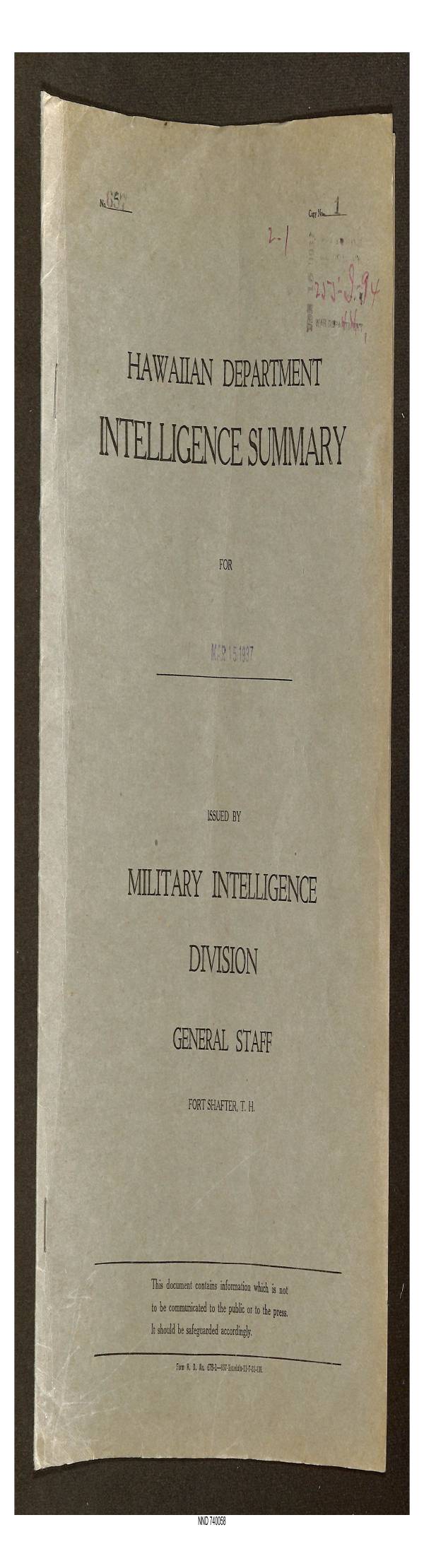
HAWAIIAN DEPARTMENT
INTELLIGENCE SUMMARY
ISSUED BY
MILITARY INTELLIGENCE
DIVISION
GENERAL STAFF
FORT SHAFTER, T. H.
This document contains information which is not
to be communicated to the public or to the press.
It should be safeguarded accordingly.
Form H. D, No, 678-1—657-Henolulu-11-7-31-1M.
�Amercian flights over regularly scheduled routes to the British
dominions was threshed out between representatives of the British,
Australian, and Nez Zealand governments in September, 1936.
PALMYRA.
Upon the return of the coastguard cutter Shoshone from
Hovland Island the navy aerdlogist assigned to aid Amelia Far-
hart Putnam in her contemplated flight made the following state-
ment about Palmyra:
"I am suggesting upon our return that the navy establish
a weather observation station at Palmyra. Such a station would
be of great benefit in solution of weather problems over the
Pacifice
"Palmyra is only seven hours by plane from Honolulu, and
directly on the route to Samoa and New Zealand. A good seaplane
landing base can be provided with only a little work on the
coral heads in the reef surrounding the main island. Even nav
planes can land there at low tide. Building of a three foot
dyke should provide tho necessary facilitics.
"In any emergency Kingman reef is only 30 miles to the
northwest of Palmyra. Supplies and accommodations could be
furnished easily.
"Eventually Palmyra will be used for aviation purposes.
I can sev no reason why it should not."
Palmyra is owned by E. Fullard-Lco of Honolulu, and has
been the scene of extensive copra gathering activities.
So far as is known no further steps have been taken since
that datc to use Palmyra as an air base.
HOWLAND AND JARVIS ISLANDS
The recent projected flight of Miss Amelia Earhart which
had planned to usc Howland Island as a base focused attention
upon this island and Jarvis Island. Tho landing field at Howland
Island is ready for Miss Earhart's arrival and press reports state
that Jarvis Island a thousand miles to the east is also being pre-
pared by the Department of the Interior as a seaplane base.
There have been no further developments relative to these
islands in the past month.
MIDWAY W. ISLANDS (See Chart IT)
Press reports of March 23rd stated that the House Rivers
and Harbors committee was expected to approve a bill authorizing
the Army to spend $1,041,000 to improve the harbor at Midvay and
$1,000,000 on harbor work at Wake Island. No further reports are
=b~
NND 740058
�GENERAL SERVICES ADMINISTRATION
NATIONAL ARCHIVES AND RECORDS SERVICE
RETURN THIS
MATERIAL
TO
THE
NATIONAL ARCHIVES Ry
;MPORTAN ali
THIS RECORD MUST BE RETURNED TO
THE NATIONAL ARCHIVES WITHIN THE
TIME LIMIT SPECIFIED IN THE COVER-
ING LOAN RECEIPT. IT 1S A CLOSED
RECORD AND THERE SHOULD BE NO
DELETIONS OR ALTERATIONS.
RETURN TO:
NATIONAL ARCHIVES BUILDING
gth and Pa. Ave., N. We
Washington 25, D. C.
ash oc 59-6711 NA-334 + FEBRUARY 1959
sores 2 (Formerly GSA Form 93)
t_ SoS
——
This document contains information which is not
to be communicated to the public or to the press
It should be safeguarded accordingly.
Form: H. D. No, 678-1—657-Honolulu-11-7-31-1M,
NND 740058
�Copy No, ==
43
HAWAIAN DEPARTMENT
INTELLIGENCE SUMMARY
ISSUED BY
MILITARY INTELLIGENCE
DIVISION
GENERAL STAFF
FORT SHAFTER, T. H.
ov,
a
This document contains information which is not
to be communicated to the public or to the press.
It should be safeguarded accordingly.
Form . BD. Rc. 618-1—651-Henolulu-11-7-31-1M.
�Record Group 165, Records of the War Department General and Special Staffs
Military Intelligence Division
Correspondence and Reports, 1917-1941
File #255-1-94/45
National Archives and Records Service
NND 740058
�NND 740058
�NND 740058
�8500---- AMELIA EARHART PUTNAM.
(Much of the material included herein, including the 4 charts,
has been furnished thru courtesy of the 14th Naval District.)
(Other material has been taken from official reports of Army
Officers who accompanied the expedition to the American Equatorial
Islands in connection with the Amelia Zarhart flight.)
Miss Harhart probably achieved more distinction than any other
woman aviator. Her outstanding accomplishments have been:
1921--Hstablished an official womn's altitude record of
14,000 fest in California.
1928--June 17. Became the first wormn to fly the Atlantic
when she crossed with ilmer Stutz and Louis Gordan
from Harbor Grace, N. F., to Burry Port, “ales, in
15 hours 40 minutes, a distance of 2,026 miles.
1930--July. Established two international woman's speed re-
cords at Dotroit, 174.9 milcs om hour ovor 100 kil-
omoter course and 181.18 miles an hour over a three-
kilometer coursd.
1928--Octobor. adc 1st solo transcontincntal round trip by
a& woman pilot.
19%1--Arril. Wade lst transcontinental round-trip in an
autosyro, covering 1,100 miles in 15 hours flying time.
1932--ihy. Took off from Harbor Grace and flow across the
Atlantic, landing in Ireland. First woman to fly the
North Atlantic alone.
1932--August. Bocxme the only woman to fly non-stop from coast
to coast and cstablished a now cross-country distance
record for women when she flew from Los Angeles to New-
ark in 19 hours 5 minutes.
1935--ay. adc the Ist non-stop solo flight from Mexico City
to Newark, flying 1,125 miles in 14 hours 18 minutes.
1935--January 12. Only porson to fly from Hawaii to the min-
lend unaccompanicd.
Fobruary 11, 1937, Miss Earhart announced a rowd-the-world
flight sponsorod and financially aided by Purdue University, Wost
lafayottc, Indiana, with whose acronautical department sho was
affiliated in an advisory capacity. Aftcr long period of testing
and proparation she took off from Oakland, California, March 17th,
on the first leg of her journcy for Hawaii, accompanicd by Fred Noo-
nan, hor navigator, and Paul Mantz, her technical advisor. The
flight was accomplished without incidont and she landed at “heoler
Fiold, Schofiold Barracks, T. He, on March 18th, after a period
of 15 hours 52 minutos in the air. Finding the length of the run-
way at “hcoler Field insufficient, in her opinion, for the heavily
loaded plane, sho decidc” to take off on the next log of her jour-
ney to Howland Island, from Luke Ficld. Accordingly she flow her
plana to Luko Fiold whore it was serviecd and gasscd; and at dawn,
March 20th, attompted to take off.
NND 740058
�Due to wnexplained circumstances a tire blew ous and the
damaged to the extent that the projected flight had
ed. The plane was shippe? by liner to the Douglas factovy in Ca
ifornia for repair.
The repair of the plane having been accomplished, Miss ¥arha rt
announced that with her navigator Mr. Fred Noonan she would resume
her flight, this time reversing her route and traveling from west
to east. The pair met with success in their flights and at 5:30
PM, Honolulu time, on the afternoon of July l, 1937, left Lac, New
Guinea for Howland Island (Lat. 0°49' Ng Long. 176943" ™) a dis-
tance of 2,550 miles.
The U. S. Coast Guard Cutter Itasca under the command of
Commandor "7. K. Thompson was dotailed to assist Miss Harhart in
her flight to Howland Island and thonce to the Hawaiian Islands,
and for this purpose =rrived off Hovland Island at 7:45 P.M.,
June 23, 1937, with the norm] crew augmented by representativos
of the Department of Interior, the U. S. Army, the U. S. Navy and
the Pross. .
Howlend Island is approximately two miles long in a North-
South direction, about one half milc in an East-est direction,
rises to a maximum clevation of twenty fect ad is surroundod by
a platform reef varying in width from 250 to 400 fect. The tom-
perature varics from 76 degrees to 86 dogrccs Fahrenhoit, with pre-
vailing winds coming from the East. As there goncrally is a heavy
surf with no anchorage, the Itasca stood off to the lec of the is-
land altornatcly drifting out with the wind and current, end stcam-
ing slowly back. There is no fresh water on the island cxecpt light
rainfall and tne only vegetation is grass, weeds anda few Kou
thickets. Guano wrkors operated on the island mony yoars ago under
the Guano Act of 1858, but this loncly spot is now wuninhabitod ex-
ecpt for the colony of cight Howniian boys placed there recently
by the Department of Intcrior. Multitudcs of rats «nd mice and
tons of thouscnds of booby birds, frigatc birds, torns and a fcow
tropic and love birds for varicty arc the only permnent inhabit-
ontse
The Itasca landcd drums containing frosh watcr ond gasoline
towing thom thru the reef by menns of a nower boat and drawing them
ashore on 2 long rope in the hands of mcn on the beach. The land-
ing field for air-planes can be classed only 2s an emergency ficld
and consists of threo runways, a North-South, Northeast-Southwest
and an East-est. The Itasca pcorsonnol with the Hawaiisn boys
worked on thc runways for two days, smoothing them ‘and placing red
flags to mark tho safcty limits.
THE FLICHT
During the aftormmoon of July lst, the Itasca roccived word that
Miss Earhart had lcft Lac, New Guines for Howland Islend at 10:00
A.M., and figurcd that she should reach Howl-nd st about 7:30 the
morning of July 2nd. Previously prepared plans were put into op-
eration, planc attendants, firc group, modical attendants, beach
patrol, off shore patrol, communications group and cormissary group
were slerted and posted. All had assigned tasks pertaining to the
arrival of Miss Earhart's planc, involving such dutics as "to cover,
vrotect and assist, (and) if necessary to rescuc her and her com-
panion! Every possible contingency was anticipitcd. In addition
to the detailed lookouts, 211 personnel on ship and shore who were
not otherwisc occupicd, spent their spare time obsorving for the
plano. A messagc was reccived that Miss Karmrt was 200 miles from
the islond and lator that she was 100 milcs avay. lvcryonec felt
assurcd thot she would arrive on schcdule, but when 7:%0 passed,
8:00 o'clock cama, and 8:30 with no word from her, anxiety grev.
23
NND 740058
�At 9:00 A.™%., & man ran from tho radio building on shorco ond shout-
od, "Earhart plane dovm north-west of thc Island! lLveryone back on
the ship". “ith the exception of a radio operator and the He waLion
boys, overyonc loaded into the lifo ports and were quickly board
tho cuttor. Nothing dcfinite was knovm. Miss Marhart had report-
od that sho ws running low on gasoline, was circling put could not
sce tho island, that sho was on 2 line of position 1579-3279 (pre-
sumably through Howland Island) and that she was flying north and
south. Her failure to give her position at anytimo during the fli-
ght madc the situation extromcly difficult for the Itasca. The
latter sniled to the northwest at high specd at 10:40 A.IM.s, on a
quest in which it was fclt chance playcd a loading rolc. It was
realized that the planc's fucl was cxhaustcd but 4° what point
londing hed been forced, a hazy intuition was the only guide.
That sho had missc@ tho island was cortain, and that hor knovm gas-
olinc supply should have carricd her beyond, was also fairly ecrtain,
put beyond that all was conjocturce
THE SEARCH.
For sixtoon days tho Itasen sailcd over the route indicated
on tho attached mp covering distanco of over 4,000 miles. Thc
course followed is showm on cnclosure "1. During the scarch the
Itasca was diroctcd to visit ccrtain of the Gilbcrt Is ands. Shore
vartios visited Arorai, Tamone ond Tarava and mtives were spoken
to off Nenouki and Nuria. No evidences of any sort regarding the
lost plane could be discovercd. The crowsnest 2nd the radio were
manncd by double shifts throughout the search. On two nights it
was thought that flashos from flaros wore sccn but whon the ship
changod its course and invostigated, it was found that the lookouts
had becn confused by stars low on the horizon, or by motcors.
Below is 2 copy of thc radio log pertaining to the poriod of
Warheart's expectcd arrival.
0345--'""/ill listen on hour and hilf hour on 3105"---(vory faint
s-1).
0400--Itasea to Harmrt. Transmitted weathcr data on 3105 K.C.
0430--Itasea to Yarhart. Transmitted woathor data on 3105 K.C.
045%--"Partly cloudy---"(vory faint $-1)
0500--Itasea to Earhart. Transmitted woather data ond asked
position.
05%0--Itasca to Harmrt. Transmitted weather d-ta and asked
position.
0600--"About 200 milos out"---(fair volumc) S-%.
0605--Itaser to Karhart. Transmittod weathcr deta
0630--Itasen to Marhert. Trensmittod weather drta and asked
sosition.
0646--"About 100 milcs out'--(good volume S-4)
0700--Itasen to Earhart. Trensmittod weathcr data and main~
tained schcdulc on 500 F.C. for "homing".
0715--Itasca to Earhart. Cannot take bearing on 3105, plcasc
send on 500 &. C. or do you wish to takc bearing on us.
No answer. Having broadcast on 500 F.C. rcsumod.
0730--Itasen to Earhart. ‘Transmitted weather data and asked
position. Having broadcast on 500 K. C.. continucd.
0741--Earhart. ‘7c must be on you but cannot soe you; but
gas is rumming low-been mable to reach you by radio,
wo are flying at 1,000 foct. (very loud S-5)
0750--Harhart. "Tic arc circling but cannot hear you. Go
ahend on 7500 with a long count, oithcr now or on the
schcduled time or half hour". (very loud and rapid. S-5)
o755--Itasen to Earhart on 7500K.%. and 3105K.C. "What is your
vosition long comt". Continuc transmission on 500 K.C.
for "homing".
Lg.
NND 740058
�075§--Barhart. "ie received your signals but are unable to get 4 mini-
mum (on her direction finder presumably oa 500 KeG.) Please
take a bearing on us and answer or S105 with voice". (ve
loud and too st for accurate r: sion. }
0805--Itasca to rt. Your
practical for us to take be
voice. Please transmit on 50
pearing. (The operator on Howland with emerge
tion finder had heard all conversation on 5105 K.C. after
0600 but was unable to, take any bearings due to the gen-=
eral difficulty and unreliability of bearings on this fre-
quency and due to the fact that she was on the air seven
or eight seconds only. In the meantime a continuous watch
on the ship direction finder (500 K.C.) had been maintained-
put at no time was there any transmission on this frequency.
080%e-Itasca on 3105 K.CG., 500 KC. Go ahead on 5105 KC. so
that we may take a bearing on yous It is impossible to
take a bearing on 5105 K.C., Please acknowledge. No ans-
wer. (Tue operator on Howland had just notified the Itasca
that he was unable to get a bearing on 5105 K.C.
0643--Rarhart. "We are on the line 157-537 will repeat message
we are on the line 157-537. (very loud and too rapid for
accurate reception. S-5.
0845--arhart. We are runniag on line North and South. (very
loud s-5, and far too rapid for accurate reception. Har-
hart sounded as if she was very excited and did not talk
distinctly. }
0b54~-Itasca. Your signals received. Go ahead with position on
3105 KC. or 500 KC. No answer.
Tne following general facts from our wir Officer's report
pearing on the unfortunate outcome of the flight.
(a) Miss Barhart did not attempt to come to on agreement with
the covering ship before her de.arture from Lae, Now Guinea,
on the technical details of communication to be followed
during the flight. Instead of making such arrangements she
issued instructions, which were fully carried out.
Sue used voico instead of key in all of uer radio trans-
missions, thereby reducing tie range of ner sete
She did not respond to repeated requests from the covering
ship for her position nor did sie at any time broadcast on
500 KiGs, as requested so that 2 bearing could be taken on
her plane during the fligit.
Except for weather reports, she did not ask for any assist-
ance from the ship, exce t at 6:12 Alb, 6:45 A.M. and 6:05
A.Me, July 2nd, wocn she requested that bearings be taken
on her on 35105 K.C., despito tne fact that she had been ad~
vised that the direction finder on the ship operated on 500
K.CG. An attempt was made to cut her in with an emergency
hign frequency direction finder, which could operate on
3105 KC. and mich had been installed on snore, without
her request or knowledge, but she wos on the air for such
prief periods (8 or 10 sec.) that tho direction finder
could not cut her in.
There was no mecting of minds during the flight. Miss Eor-
hart mained on tie air for but brief periods of time, did
ormst to find out if her messuges had been received,
fledged the recoipt of but ono messuge from the
i the fact that tho ship was heard at San Fran-
and by HileS. "Aachillos", cnroute from New
Sno came on tno air for < fow seconds,
spoke a few words, and then cut off.
NND 740058
�Except for supplying weather reports from Pearl Harbor and mak-
ing available the services of the tenders "Swan" 2nd "Ortario,"
which were on station to guard the flight - the "Svan" standing by
midway between Honolulu and Howland and the "Ontario" about
way between No:7 Guinea and Howland =~ the U.S. Nevy had no conn
ion with the flight.
After failure of the flight became a practical certainty,
Nwwal authorities at Pearl Hurbor conferred on measures to bo taken.
It was agreed that no Naval vessel regularly stationed in ailan
waters was suitable for search operations in the distant area but
that a patrol seaplane could reach dowland Island and, providing
conditions were favorable, carry out limited operations, basing
on the "Itascas" Mcanwhile, Roar admiral Orin S. Merfin, Command-
ant of the 14th Neval District, Pearl Harbor, had been directed by
the Navy Department to use 911 available N-val facilities in the
search. It was then decided to dispatch a seaplane to Howland and
ag 7:03 P.il., July 2nd, patrol plane 6-P-3, with a crev of cight,
commanded by Lt. ile We Harvey, left Pearl Harbor for Howland. The
"Itasca" vas directed to stand by at Howland to tend the plane, and
the "Svan" to proceed toward Howland.
Admiral Murfin was authorized by \/-shington to divert the
"Colorado," then in Hawaiian waters, from her R.O.T.C. cruise to
join the search, and at 9:15 P.M., July 2nd, the "Colorado" is
ordered to proceed when fueled. Sane left for Hovland the next
morning, July 3rd, with directions to search first the southoast
quadrant from Howland and the Phoenix Islands.
At 7:10 A.M., July 3rd, the patrol plane 6-P-3 reported that
it had encouutered © sovere storm and ws returning to Pearl Har-
pore Available surface craft wore dispatched from Pearl Harbor to
cover the return flight of the plane in case of fuel shortage, but
these precautions proved unnecessary and tho plane reached Pearl
Horbor at 7:26 P.ll., July 3rd, 24 hours and five minutes from the
time of its departuro; after flying 2,570 miles non-stop, under
very trying conditions.
The possibility of scarch oporations by sca plancs basing on
Johnston Island was considered but rejected as impracticable be-
causo of tho 2,200 milo turn-around bot:ecn Howland and Johnston
Islands. It wos thon decided that m airplone carricr vould be
tho most practicablo and efficient unit. Accordingly, on July 4th,
the "Loxington Group" was orgenizod on the Pacific coast, consist-
ing of the carrier "Lexington" and the destroyors "Lamson," "Dray-
ton," “Cushing,” and "Perkins." Tho latter vosscl was later vith=-
drawn from tho group becuuse of machinory trouble. Under command
of Captain J.S. Dowell, this group wus assembled and departed for
Howaii July 4th, for fuoling, arriving at Honolulu und Lahaina, July
8th, end departing July 9th.
On July 6, Rear Admiral Murfin assumed command of all Navel
forces ongaged in tho search, and on that date tac "Itasca" was
ordercd under Naval jurisdiction, continuing in that status until
July 16. Cagtain WL. Friodoll, commending tho "Colorado," which
was then noaring its objective point, was directed to take charge
of all vessels in tho soarch aroa until the arrivel of the common-
der of Destroyer Squadron 2,(Commanding the "Lexington Group, ")
when the latter would take over co nde To offect the roloase of
tho "Colorado" at the carliest practicable date, it was decided
that sho should soarch the Phoonix Islands and vicinity, then pro-
ceed to rendezvous with ond fuol the "Lexington Group" destroycrs.
This was accomplishod, July 12, and tho "Colorado" rolecsed from
further duty in connection with the soarch. aotain JeSe Dowell,
ding Destroyer Squadron 2, took over commnd of 211 units upon
rival in the soarch ares, July 11.
qe
ie
NND 740058
�Tho initial phoso of the search covercd the orca north of and
fairly near Howlend Island, July 2-5. ‘Then, on the
io intercepts which appeared at the time to be rol
later discredited, the soarcn shifted to the weety
miles to northward of do d. The second purse of
to the southsnctorn quadrant on the basis of ra
pearings and other considorstions inici indicatcd tt
minotod.. the thixd phase +
ii the at) probably +
sequent drift would nave moved it to the wes
in the li-doy interval prior to arrival of the
“Lexington Group" coverod an ares aporoximatsl,
tho west and northwest of Howland. As an additional possi
the Gilbort Islands wore searched.
search
operations:
Miles stcamed by vossols on route to and during search-—-Ag ,000
Miles flowm by planes --149 ,000
Plane hours in air--------------- ae amie ie eel ae BA
Square miles sosarched:
By vossois---—----= i ssn een nee en a ee en ee
-167,481
262, 261
In addition to the "Itasca," tho sea and acrial search ultimatc-—
ly involvod nine naval vessels and about 66 nlanos, including the
landplanes of the carrier "Lexington", three obsorvation seaplanes of
the "Colorado," and the mval patrol seaplane 6-P-3, with total per-
sonnel of about 3,000. The British cruiscr His “Achilles,” then
en-route to Honolulu for 4 visit, the British Freighter "Moorby,"
and certain olements of the Japanese Navy and Air Force then in Japan's
mandated territory, also entered tho search.
In connection with the search, it is interesting to note that
66 Novy plenes flew more then 1,500 hours and 150,000 miles, vut
all over water without loss of life or property damage. One of the
outstanding performances of the search was the flight of the Ney
patrol seaplane from Pourl Harbor mentioned previously.
The Paradise of tho Pacific, monthly magazine ‘ublished at Hon-
olulu, ably sums up the probable benefits to be derived from this ox-
tensive search operation, as follows:
".eee0 Those operations, recoiving national publicity,
made Americans more P:.cific-Air conscious; may result in
the elimination of many air hazards of Over=-Pacific avidtion
and make tho Awcrican Pacific safer for air @mmerce; may cn-
courage Congress to give the Nevy what it needs in the wy
of supplementing the patrol pombing planes with adequate sur-
face craft and other essentials; may attract constructive
attontion to tie tremendous air efforts being made by other
countrios in the Pacific area; may result in America secur-
ing netionel possession of cortain Pacific Islands; and may
specd up Pacific air matters in generale"
{ ; F
by daca, V. soto Ay
SIDNEY V. BINGHAM,
Licut. Colonel, G. S. Ces
A. Co of Se, Gee.
NND 740058
�| TION
& 2025
PLANE'S LINE OF POS
BROADCAST AT 2013;
X 205 HRS, AT
ttl aNOTS
\
‘ \
mosr
\
oF .
: PROBABLE AREA
GILBERT_ IS.
is
NARAU
nO er
17390
‘ «POSITION AT WHICK
’ LAST STAR SIGHTS
3S. Myrricsann COULD BE OBTAINED
ae
>
—-—U3.5. ONTARIO
Sraripe Snee
=
: 0720
“ONLY POSITION REPORT
ALL TIMES ARE Gc
RECIEVED SHOWS PLANE siti: henge deait
N COURSE SPECO NN) ANOTS S- CURRENT RE
scigcs aie eat BY SAILING DIRECTIONS
L- GURRENT EXPERIENCED
BY LEXINGTON
180
EARHART FLIGHT INFORMATION
NND 740058
�PRBGOCA: Sasnen nen
Piane 2-1/8 Jucry /9F7
Mies Caeisae ¥IZY
SCate 12°28"
NND 740058